源 流

The lineage

Long before the printing press reached Europe, scholars of the Tang and Song dynasties were mapping the heavens onto the human life. They watched how the ten celestial stems and twelve earthly branches turned in the calendar, and they noticed: the moment a child takes their first breath leaves a fingerprint.

Two systems crystallized from these observations. BaZi, the eight characters, reduces a life to its elemental architecture. Zi Wei Dou Shu, the Purple Star, places one hundred and eight stars across twelve life palaces. Together they have guided emperors, merchants, and farmers for over a thousand years.

千 年 流 变

A thousand years of refinement

BaZi and Zi Wei did not appear all at once. They were shaped over six dynasties, and continue to be refined today.

Han
206 BCE – 220 CE

The calendar takes shape

The sexagenary cycle of ten Heavenly Stems and twelve Earthly Branches becomes the official method of recording years, months, days, and hours. The Five-Element framework is codified by scholars such as Dong Zhongshu. The raw material of every later system is now in place.

Tang
618 – 907

The first system of fates

Li Xuzhong (李虚中) builds the first reproducible method for reading a life from the year, month and day of birth. His treatise survives and is the recognised seed of all later BaZi practice.

Song
960 – 1279

Xu Ziping reorders the system

Xu Ziping (徐子平) moves the centre of analysis from the year stem to the Day Stem, the moment that defines the modern art. The Yuan Hai Zi Ping is compiled. In parallel, the school of Chen Tuan develops what becomes Zi Wei Dou Shu.

Ming
1368 – 1644

The canon is closed

Wan Minying compiles the encyclopaedic San Ming Tong Hui. The Zi Wei Dou Shu Quan Shu fixes the Purple-Star canon. The two great systems of Chinese personal analysis reach their classical form.

Qing
1644 – 1912

Commentary and refinement

Shen Xiaozhan writes the Zi Ping Zhen Quan; Ren Tieqiao re-annotates the Di Tian Sui; the Qiong Tong Bao Jian organises seasonal practice. The art deepens from rule-following to chart-reading as a literate skill.

Modern
1912 –

Computation meets tradition

From Hong Kong, Taiwan, Singapore and Malaysia, twentieth-century lineages, Liang Xiangrun, Xu Lewu, Liao Mingxiong and others, bring the classical canon into the computer age. Charts that once took an hour with brush and almanac are now drawn to the minute, but the texts they consult are unchanged.

WOODFIREEARTHMETALWATER五行wǔ xíng
五 行

The Five Elements

Wood, Fire, Earth, Metal, Water — the elemental grammar shared by BaZi, Zi Wei Dou Shu, Chinese medicine, and the imperial calendar. The outer cycle (相生) shows how each element gives birth to the next; the inner star (相克) shows how each element restrains another. A reading is, in part, the work of listening to this conversation inside your chart.

Recorded systematically in the Han-dynasty Huángdì Nèijīng and threaded through every classic that followed.

八 字 之 典

The BaZi canon

Six classical texts that every serious reader still consults. We do not invent doctrine; we draw on these.

《李虚中命书》

Tang Dynasty
Lǐ Xūzhōng Mìng Shū · Li Xuzhong's Book of Destiny
Li Xuzhong (李虚中, 762–813)

The earliest surviving treatise of the Three-Pillar method that became BaZi. Li Xuzhong, a Tang official and scholar, was the first to systematically use the year, month, and day of birth, with hidden stems and Five-Element relationships, to read a person's destiny. His method was later expanded to four pillars by adding the hour.

《渊海子平》

Song Dynasty
Yuān Hǎi Zǐ Píng · The Deep Sea of Zi Ping
Attributed to Xu Ziping (徐子平), compiled in the Song

The cornerstone of modern BaZi. Compiled in the Song from the work of Xu Ziping, who shifted the Day Stem (rather than the Year Stem) to the centre of analysis. Every serious practitioner since the Song begins here. The system of Ten Gods, useful gods, and ten-year luck pillars all crystallized in this text.

《三命通会》

Ming Dynasty
Sān Mìng Tōng Huì · Comprehensive Compendium of the Three Fates
Wan Minying (万民英, 1521–1603)

An encyclopaedic Ming-dynasty work in twelve volumes that gathers and reconciles the BaZi schools that came before it. Wan Minying, a Ministry of War official and lifelong scholar, drew on imperial archives to produce what remains the most comprehensive single reference in the tradition.

《滴天髓》

Ming–Qing
Dī Tiān Suǐ · Drops of Heavenly Marrow
Attributed to Liu Bowen (刘伯温, 1311–1375), annotated in Qing

The most poetic, and most demanding, text in the canon. Traditionally attributed to Liu Bowen, strategist to the Ming founder, and re-annotated in the Qing by Ren Tieqiao (任铁樵). It moves beyond mechanical formulas to teach how to read the spirit of a chart: balance, climate, the conversation between elements.

《子平真诠》

Qing Dynasty
Zǐ Píng Zhēn Quán · True Commentary on Zi Ping
Shen Xiaozhan (沈孝瞻, Qing dynasty)

Shen Xiaozhan's Qing-dynasty masterwork on the doctrine of useful gods (用神) and chart structures (格局). Where the Yuan Hai gives the alphabet, the Zhen Quan teaches the grammar, how a chart's underlying structure governs everything that follows.

《穷通宝鉴》

Qing Dynasty
Qióng Tōng Bǎo Jiàn · Precious Mirror of Adversity & Prosperity
Compiled by Yu Chunwu (余春煜), Qing edition

Also known as the Lan Tai Miao Xuan (栏台妙选). A practical Qing handbook organised by birth month and Day Master, distilling rules of seasonal favour: which elements a Day Master needs in summer's heat, in winter's cold, in spring's rising and autumn's harvest.
紫 微 之 典

The Zi Wei Dou Shu canon

Three foundational works behind every Purple-Star reading.

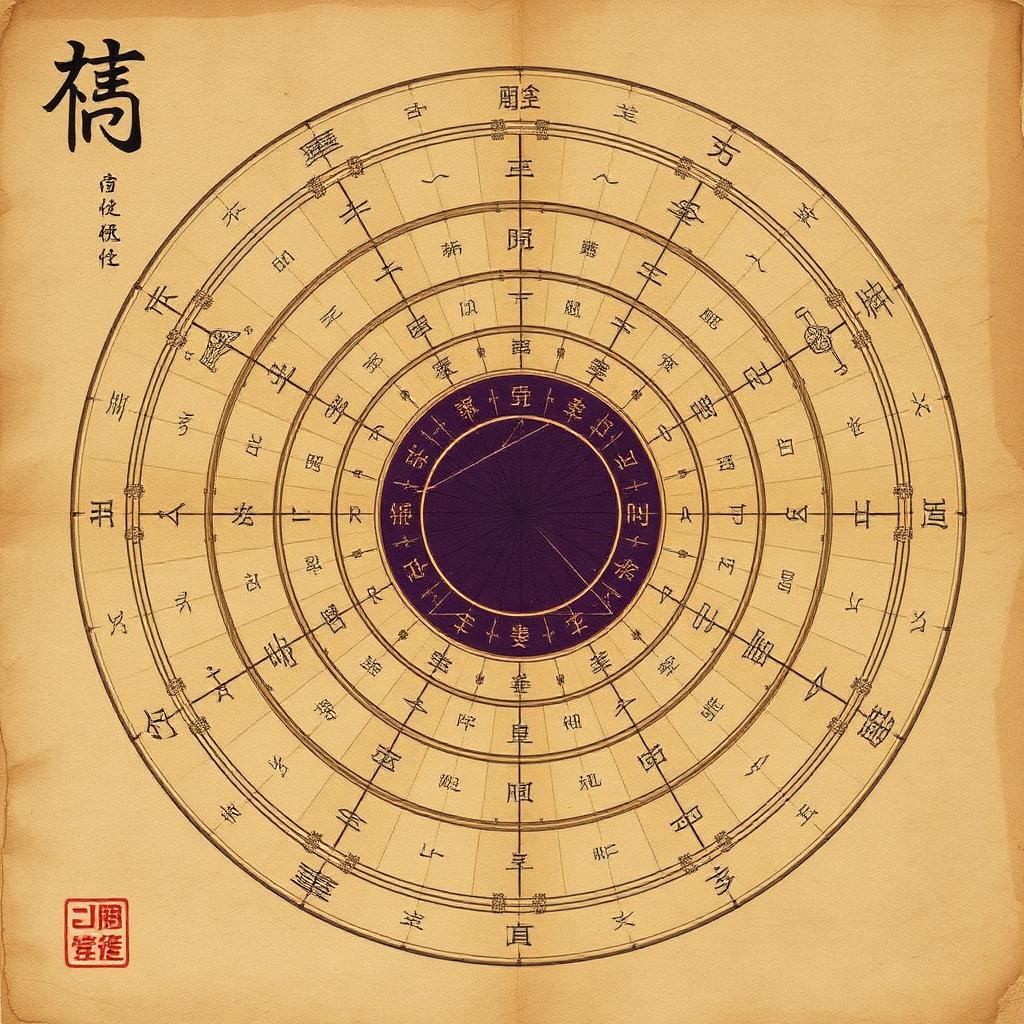
Circular Chinese star chart in the style of the Song-dynasty Suzhou astronomical stone, showing the Purple Forbidden Enclosure surrounded by the twenty-eight lunar mansions.
紫微垣 · After the Chunyou Tianwen Tu (淳祐天文圖), Song dynasty, 1247

《紫微斗数全书》

Ming Dynasty
Zǐ Wēi Dǒu Shù Quán Shū
Attributed to Luo Hongxian (罗洪先, 1504–1564)

The standard reference of Zi Wei Dou Shu, compiled in the Ming and traditionally attributed to Luo Hongxian. It fixes the placement of the fourteen main stars, the auxiliary star groups, and the rules for reading the twelve palaces, the basis on which every modern Zi Wei reading rests.

《十八飞星策天紫微斗数》

Song Dynasty
Shí Bā Fēi Xīng Cè Tiān Zǐ Wēi Dǒu Shù
Lineage of Chen Tuan (陈抟, 871–989)

The earliest text in the Zi Wei lineage, descended from the school of Chen Tuan, the Daoist sage of Mount Hua. Eighteen flying stars are placed and read in dynamic combination, the prototype of palace-based astrology in China.

《紫微斗数全集》

Ming Dynasty
Zǐ Wēi Dǒu Shù Quán Jí
Attributed to Luo Hongxian (罗洪先, 1504–1564)

A companion compendium to the Quan Shu, expanding on the four transformations (四化), the small star sets, and case-based examples. Together with the Quan Shu it forms the closest thing to a standardized syllabus the tradition has.

推 演 之 法

How a reading is actually drawn

Not from intuition, not from a fortune-cookie database. From rules these texts spell out.

Solar terms, not lunar days

The month pillar changes at one of the twenty-four solar terms (节气), not on the first day of the lunar month. Skipping this is the single most common error in casual online calculators.

True solar time

The hour pillar is set by the sun's position at the birthplace, not by political clock time. We correct for longitude, daylight savings, and time-zone history before drawing the chart.

Twelve palaces, not twelve houses

Zi Wei palaces are seeded from the lunar month and birth hour, then the fourteen main stars are placed by the Five-Element Bureau (五行局). The math is fixed by the Quan Shu, there is no room for improvisation.

Ten-year luck pillars

The 大运 are derived by counting forward or backward from the birth solar term, three days to a year, with direction set by the year stem's polarity and the chart-holder's gender. This is in the Yuan Hai, in plain ink.

We are not a fortune-telling app. We do not promise the future. What we offer is a careful, hand-prepared reading, your chart calculated to the minute, then interpreted by a reader who takes the tradition seriously, in clear English written for someone who has never met it before.

If you find a reading useful, return for one. If a reading does not speak to you, that is honest information too.